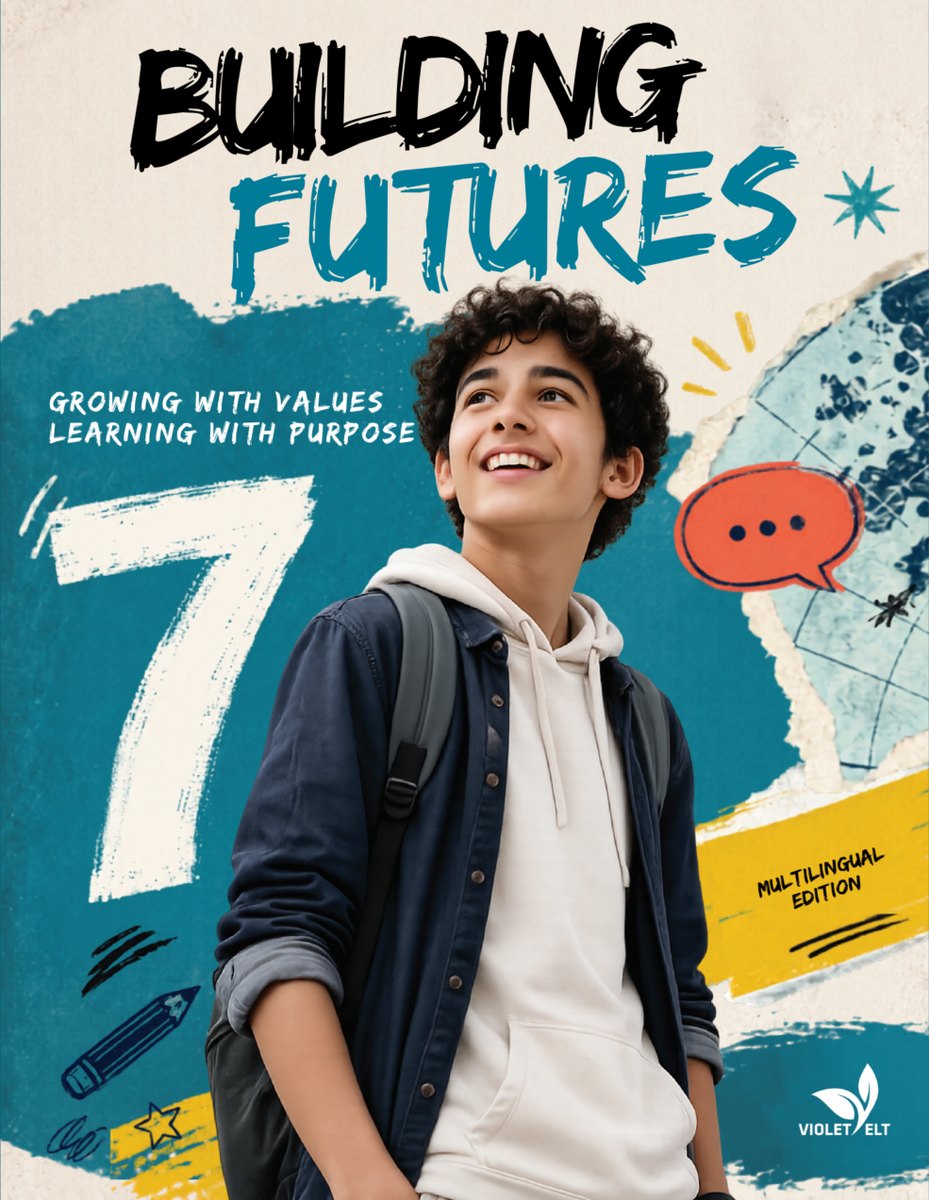
Building
Futures
Growing with values, learning with purpose.
One unbroken journey from a child's first English words at seven to confident, independent communication at thirteen.
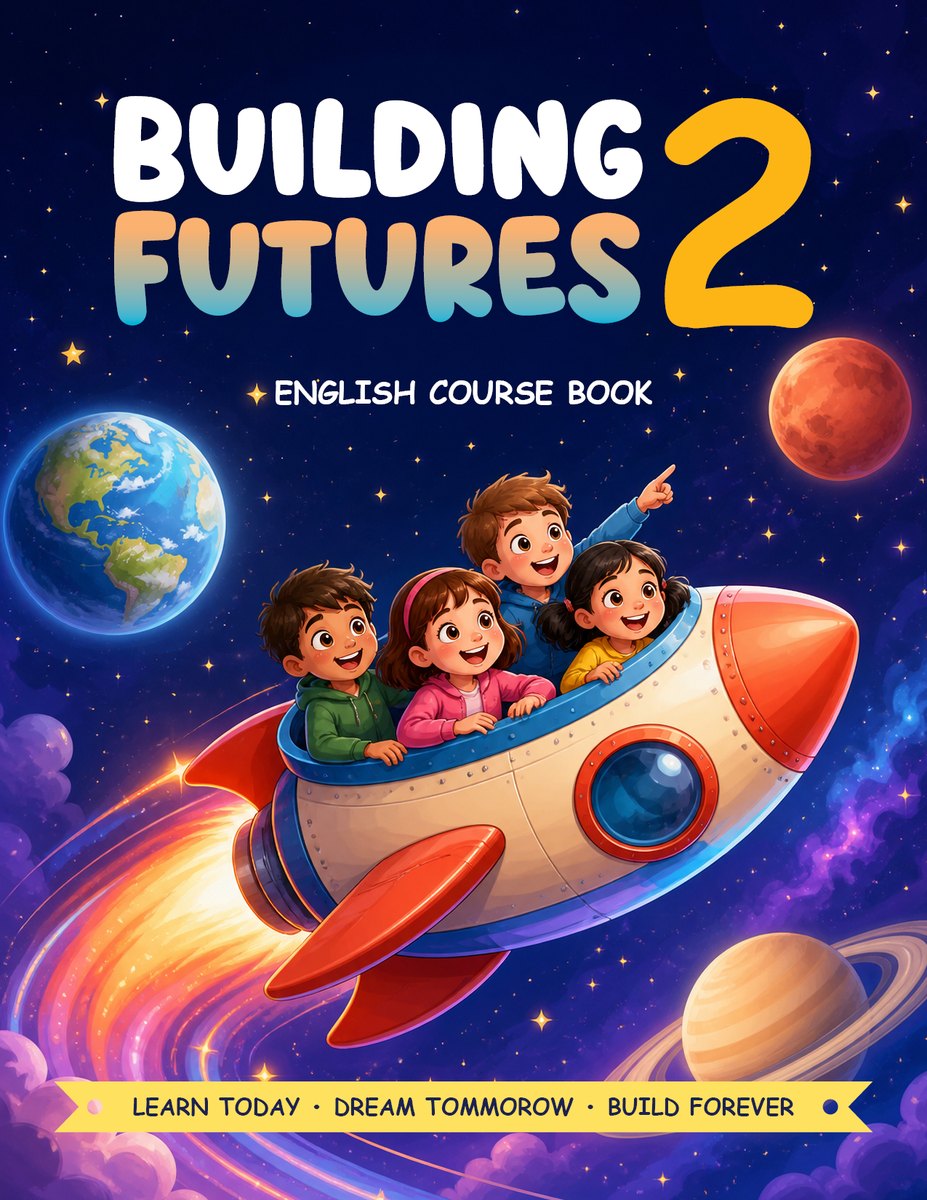
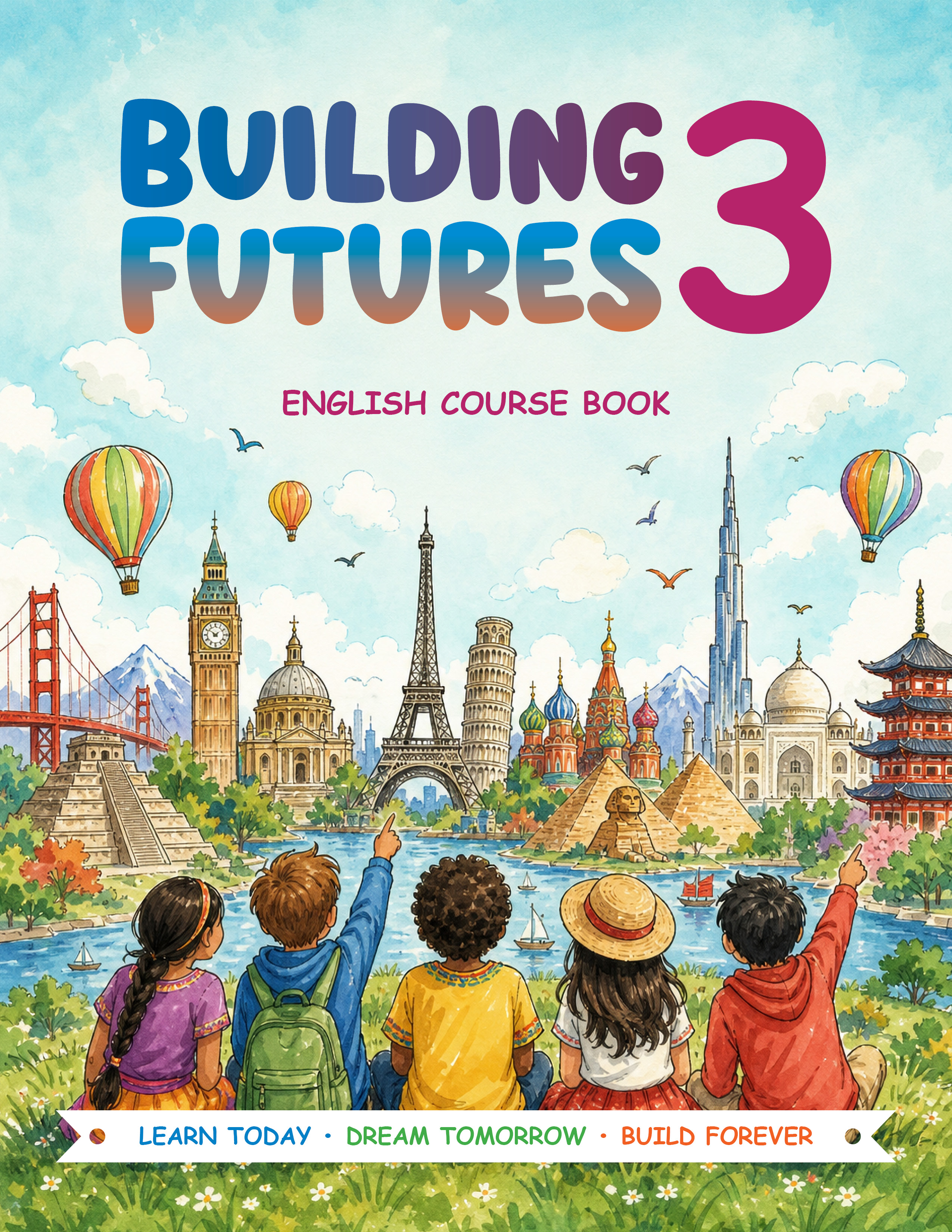
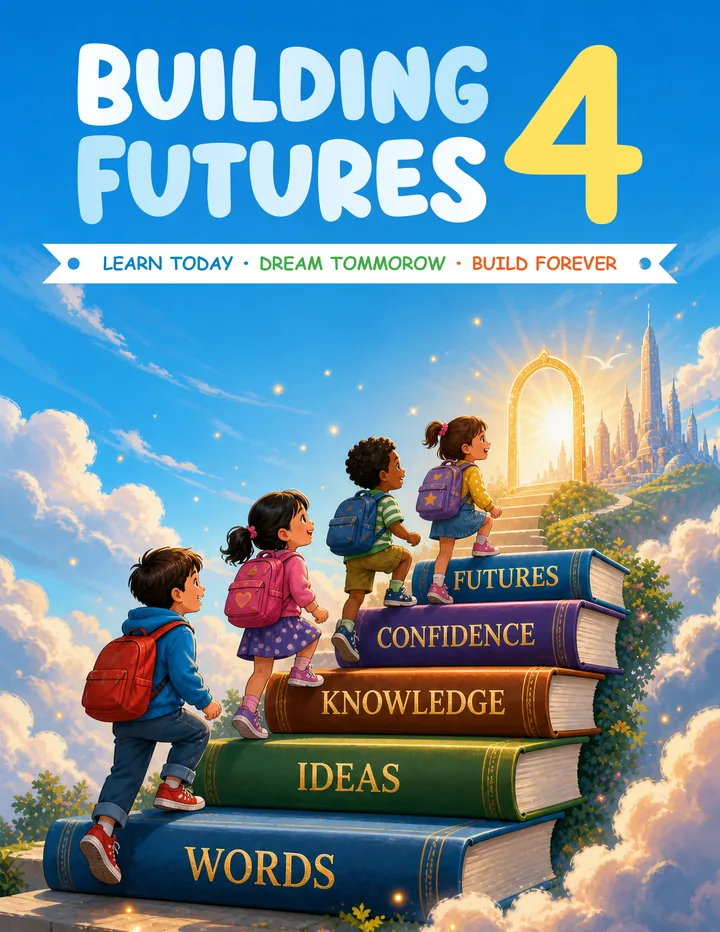
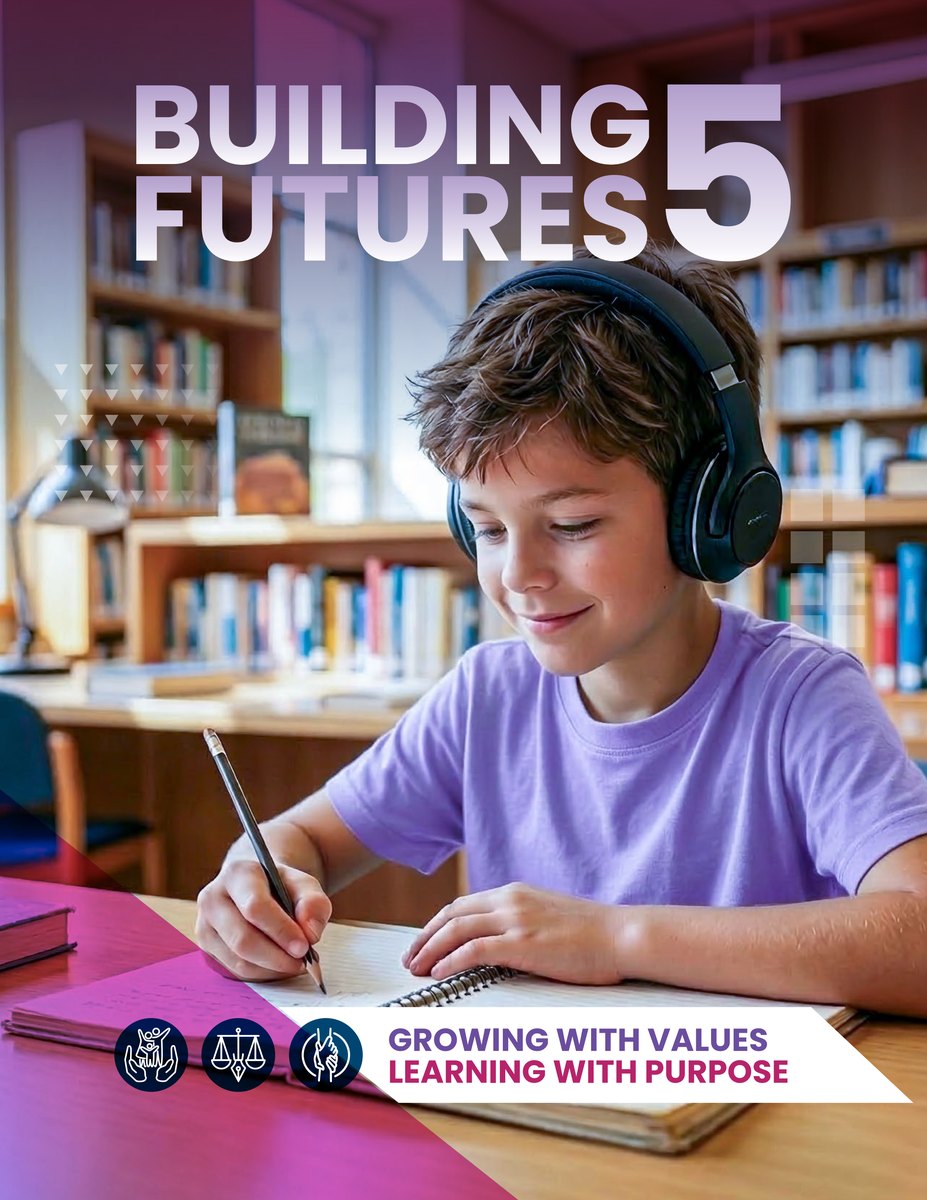
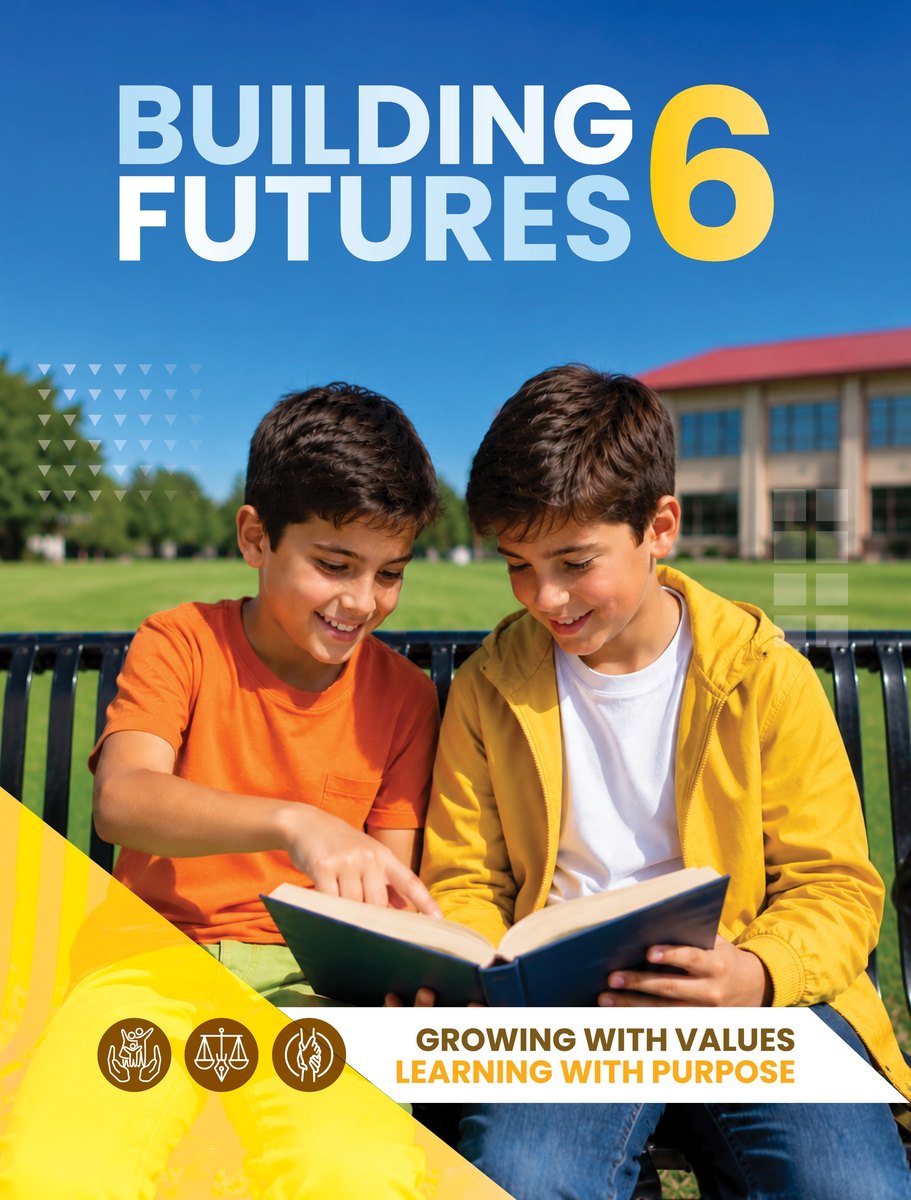
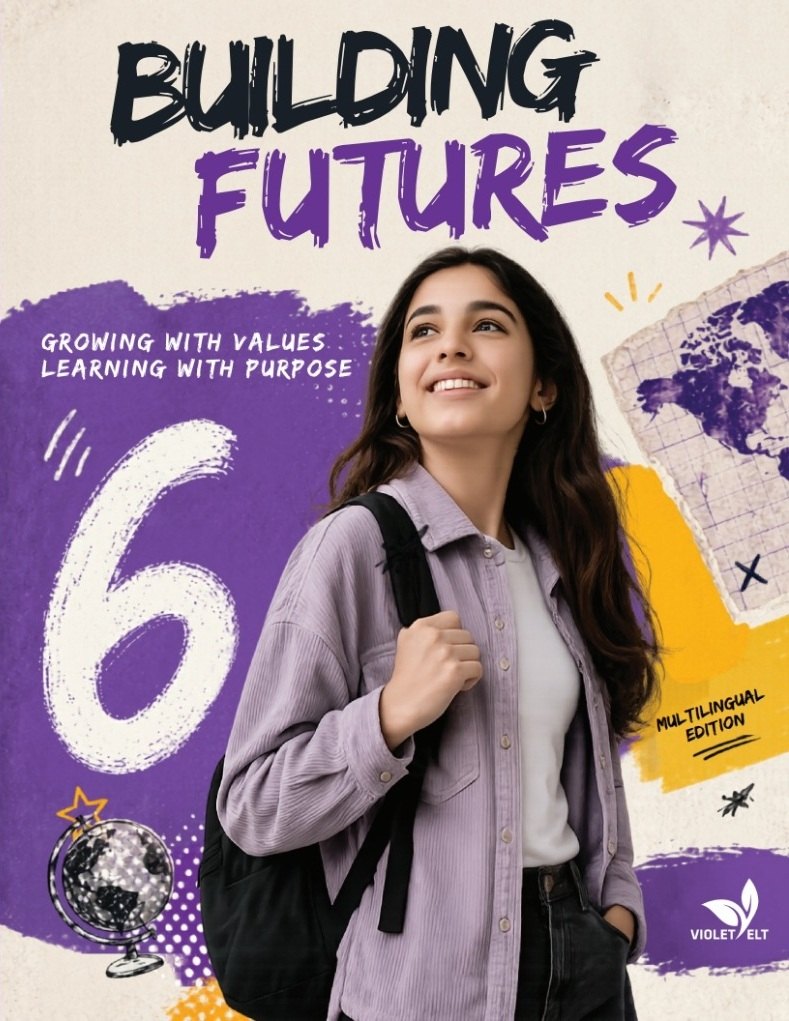
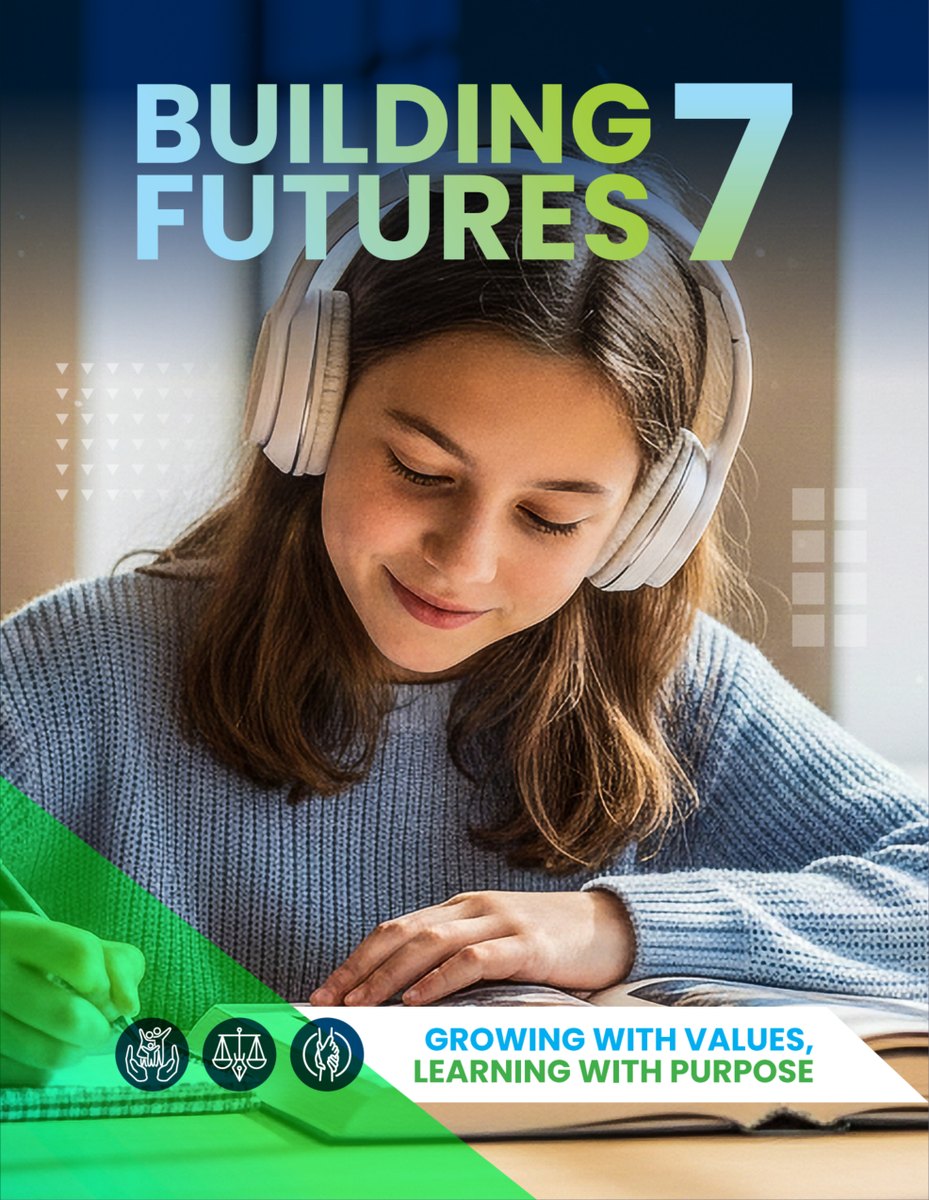
One series. One method.
Every grade of the journey.
Building Futures carries learners from their very first English words at age 7 to confident A2+ communication at 13, with one consistent pedagogy, one values framework, and a design language that grows up with the child.
two strands
ministry-mapped
taught in context
through every level
official curriculum
A staircase without gaps
Each level hands off precisely where the next one begins. No repeated years, no sudden leaps: a calibrated CEFR climb from absolute beginner to the threshold of independent use.
Bar height maps each level to its CEFR band. The Multilingual editions sit above their general-strand counterparts on intensive hours and a denser syllabus.
Discover, don't drill
Every word and structure is met inside a story before it is ever practised: an animated digital story in the primary years, rich multi-format listening at secondary. Nothing is pre-taught cold, and nothing is tested before it has been met in context.
Story first
Learners watch or listen before anything else. A 1 to 5 minute story carries all the unit's target language in one memorable context: characters, plot, emotion.
Back into the text
Guided-discovery tasks send learners back into the story to find the words and patterns they already understood. Language is recovered, not introduced.
Ending in the personal
Practice climbs from controlled to free, always ending in personalisation: the learner saying something true about their own world.
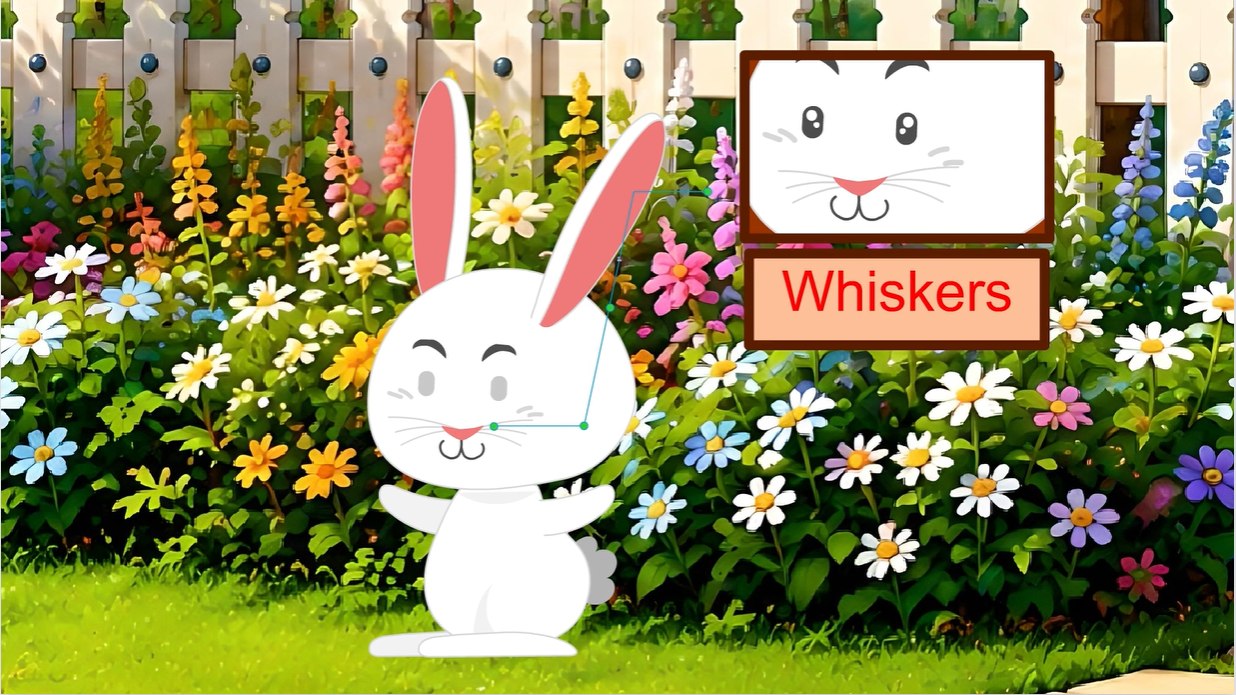
18 original animated stories anchor the primary books. The Multilingual editions build each unit on three natural listening tracks plus a CLIL listening: 64 scripted audio pieces across the strand.
Growing with values,
lived and never lectured
- Türkiye's 20 core educational values, curated to 2–3 per unit across every level of the series.
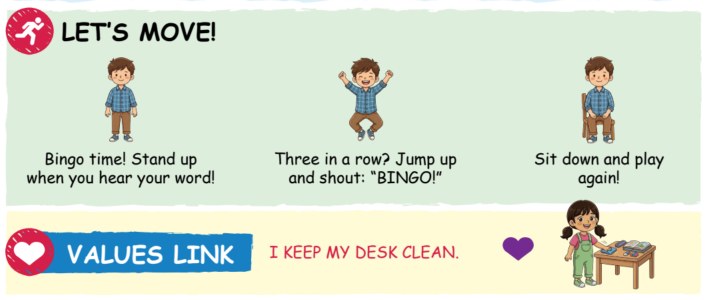
- On student pages, a value is always a concrete first-person action with an illustration: "I help my new classmate." · "I keep the sea clean." · "I don't waste food." Never an abstract label.
- Values appear at fixed points: the unit opener, inside the story, in the project, and in a closing self-reflection checklist.
- Social-emotional learning is structural: cooperation, self-awareness and responsible decision-making are built into pair work, group roles and reflection.
Bodies move, hands make
Engagement is engineered, not hoped for. The mechanism matures with the learner.
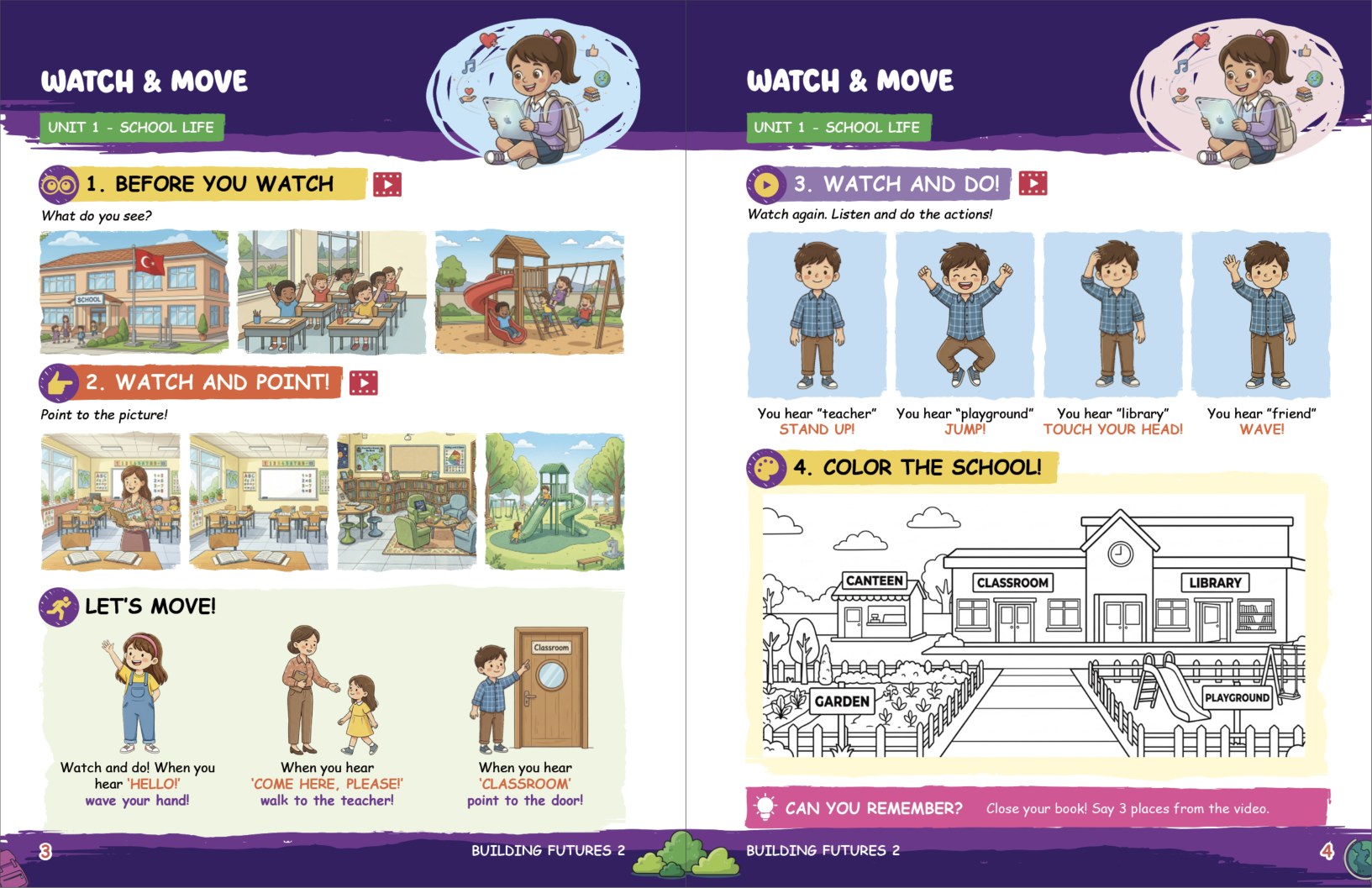
Grade 2 has movement in every single section, even inside the videos: "Point to the library!" Grade 3 carries 70+ "Let's Move!" moments. Children respond physically before they must speak, lowering the affective barrier.
Movement-based speaking tasks continue, and every unit now ends in a collaborative project with rotating group roles, plus a second, lighter CLIL project. Up to 16 hands-on builds per book.
The cognitive climb, engineered into every unit
Recognise
Label
Use chunks
Personalise
Produce
Task demand visibly grows within each unit, never point-and-match on repeat. Spaced "Can You Remember?" retrieval boxes between sections make it stick.
English as it actually exists
From the first grades, learners read and produce real text types, not coursebook-ese.
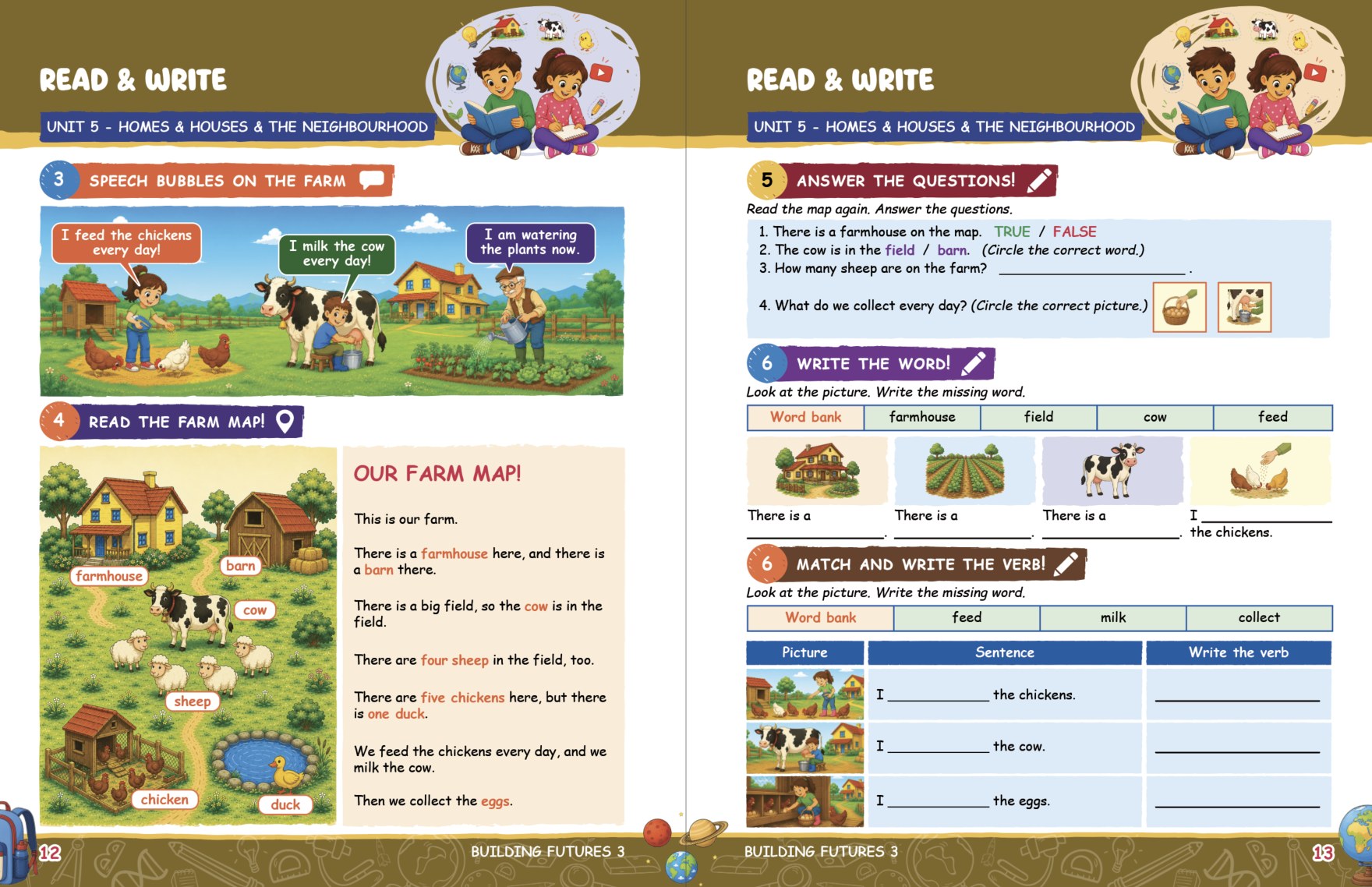
Grade 3 reads a real document every unit: an invitation, timetable, weather card, fridge note, farm map, café menu.
Grade 4 rotates real genres: poster, personal letter, family album, mini-CLIL info text, travel brochure.
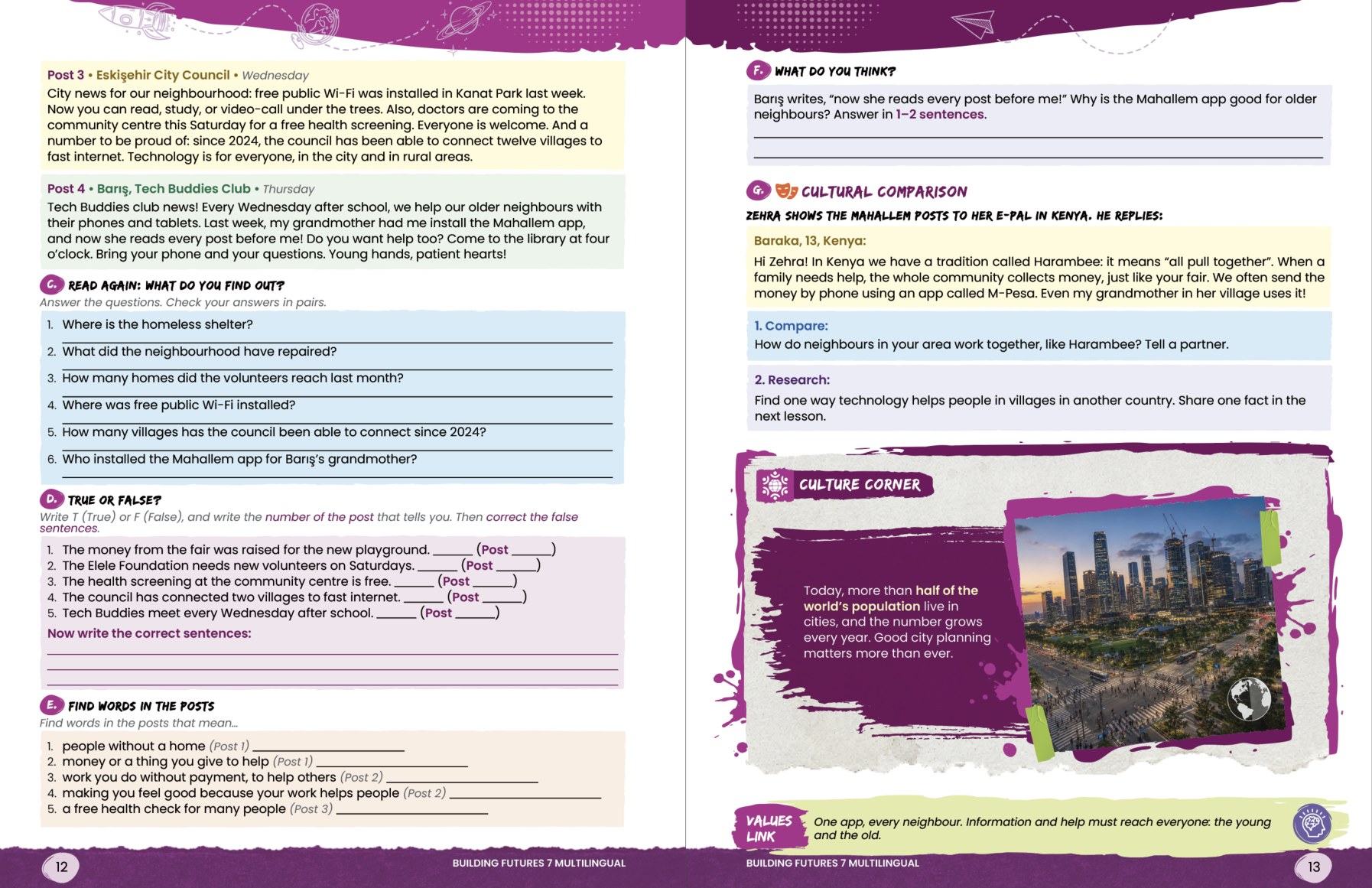
From Grade 5: chat threads, social posts, vlogs, podcasts, voice notes. Plus idioms people actually say: "That's the lion's share!"
Every Multilingual unit ends its reading with a Cultural Comparison from a peer abroad, from Japan's o-souji to Finland's recess.
Where the
journey begins
- The most visual book in the series: 80 : 20 pictures to text. Genuinely usable by pre-literate, true-beginner 7-year-olds.
- Movement in every single section, with TPR cues even inside the story videos. The most kinaesthetic level.
- Six 1–2 minute animated stories introduce every word in context before any page work begins.
- Zero explicit grammar. To be, have got, there is/are live entirely inside repeated chunks. No intimidation for children or their teachers.
- A structured A–Z phonics strand and trace-and-copy writing meet children exactly where their literacy is.
numbers & colours
13 per unit
include TPR
Watch it, act it, make it
Each unit opens with an animated story starring Turkish-named characters, vocabulary as big on-screen labels, and actions to copy. A three-viewing model: gist → act along → respond.
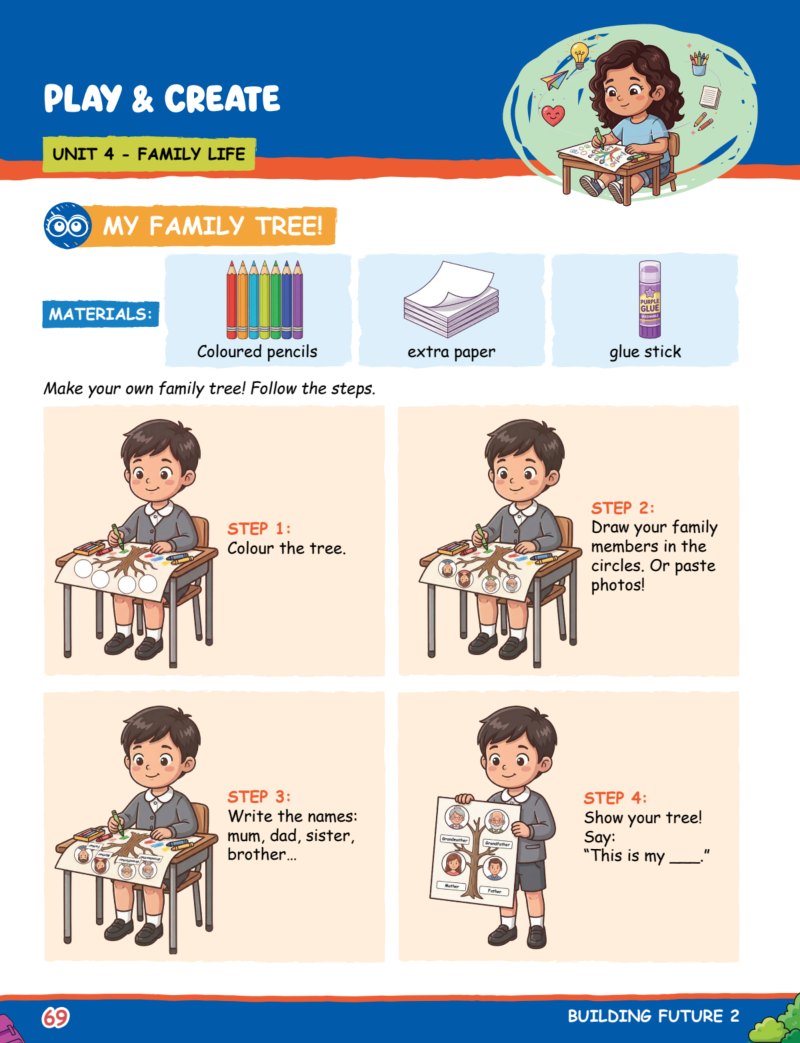
Every unit ends in a tactile show-and-tell build: a cardboard school, a labelled "sweet monster", a family fact file with avatars. Colourful, photographable, parent-pleasing.
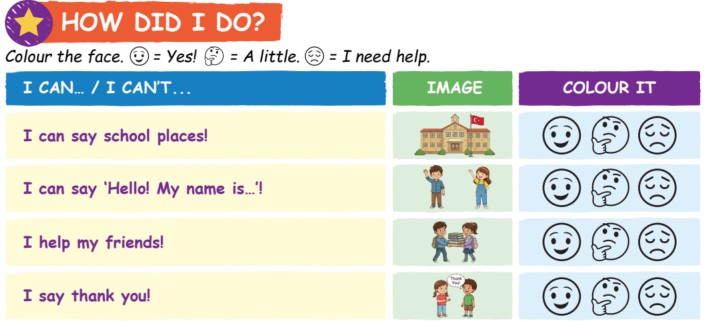
Units close with "How did I do?": children colour 😊 😐 😟 against picture-supported goals like "I can say five colours" and "I wash my hands."
The bridge year
- Where reading and writing come online. The visual ratio shifts to 65 : 35, and children read their first connected multi-sentence texts, safely inside Pre-A1 → A1.
- Authentic "realia" reading in all six units: a birthday invitation, a class timetable, a weather card, a fridge note, a farm map, a café menu. Children learn to read the documents they'll actually meet.
- A real A1 grammar set taught by pattern, not rules: there is/are, have got, can, must/mustn't, present continuous and simple.
- Strong CLIL for an 8-year-old book: counting in tens, weather science, healthy habits, even reading a café bill.
- A recurring Turkish cast (Elif, Mehmet, Zeynep, Ms. Aydın) returns from Grade 2. Continuity children invest in.
one per unit
TPR moments
across 6 stories
Real English, real payoff
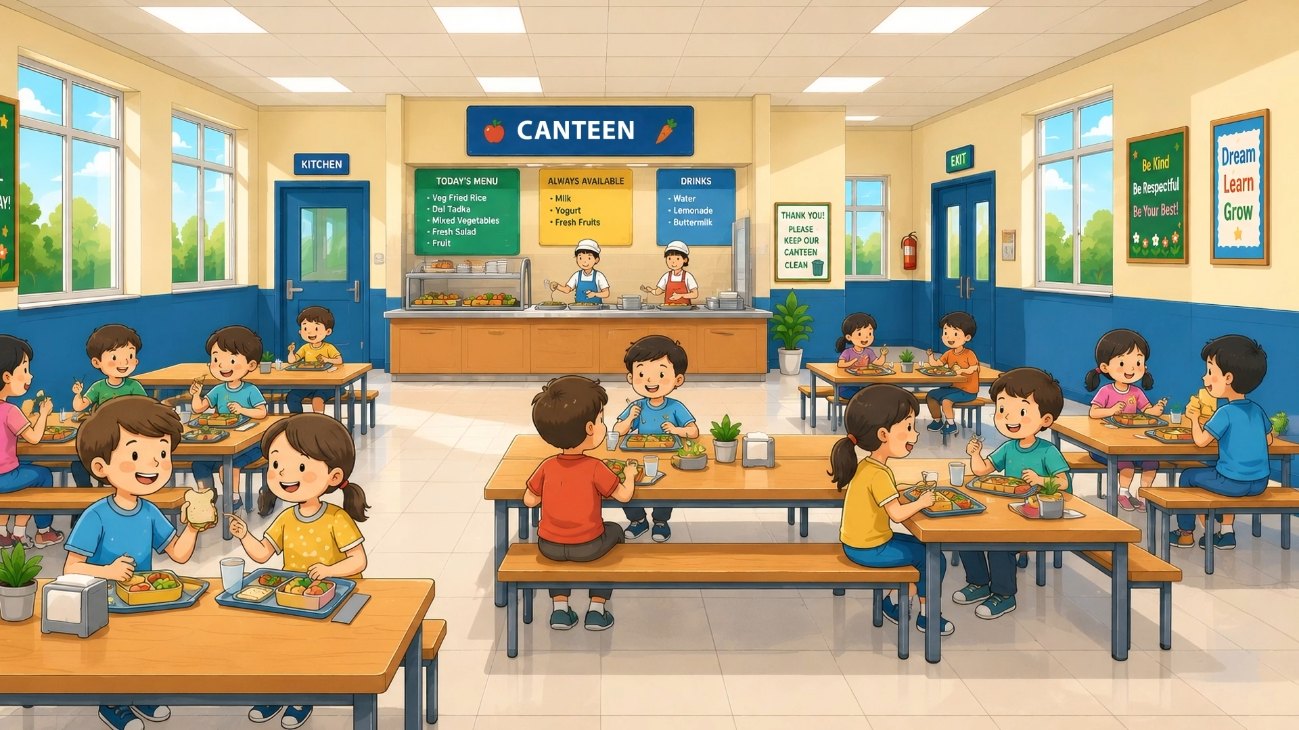
A whole café role-play unit. Children make their own menus, run an "Order Up!" waiter-and-customer game ("Can I have some soup, please?"), and even learn what a bill is.
City-girl Defne's farm visit powers a genuine information-gap game ("My Farm / Your Farm: Secret Numbers") and a hands-on paper Mini Farm build.
Six real document types across the book, each with true/false and Wh- questions. A series-defining reading innovation at this age.
A1, made solid
- The full A1 grammar spine: past, present and future, through picture-only Pattern Boxes. Was/were, past simple, could, comparatives, will, be going to. The widest structural range in the primary series, with zero metalanguage.
- Text finally does real work. Every unit carries a genuine 8–10 sentence reading in a rotating real genre.
- A cast that grows with the child. Class 4-A runs through all six units; shy Kaan literally becomes the class storyteller.
- Real communication with report-back in every unit: surveys, reporter interviews, info gaps, always ending in full-sentence reporting.
- Zero-prep, zero-cut crafts that rotate every unit: invitation card → poster → family mini-book → lift-the-flap → brochure.
recycled in 3+ sections
families
activities
Secondary school,
started right
- A genuinely implicit grammar engine at exactly the right moment. ~30 structures absorbed from story context, never a rule box in sight.
- Each unit is driven by one 4–5 minute digital story: a coherent narrative hook for ten hours of lessons.
- A complete pronunciation journey: every letter-sound a–z across the year, intonation patterns, and the exact minimal pairs Turkish speakers struggle with (/w/–/v/, /θ/–/ð/, /ɪ/–/iː/).
- A widening thematic arc from the classroom desk to the universe. Perfect recycling, satisfying progression.
- Modern, age-true framing: chat messages, voice notes, drones, recycling tech, Türkiye's space programme.
eight themes
group projects
coverage in one year
From dream classrooms
to wild savannahs
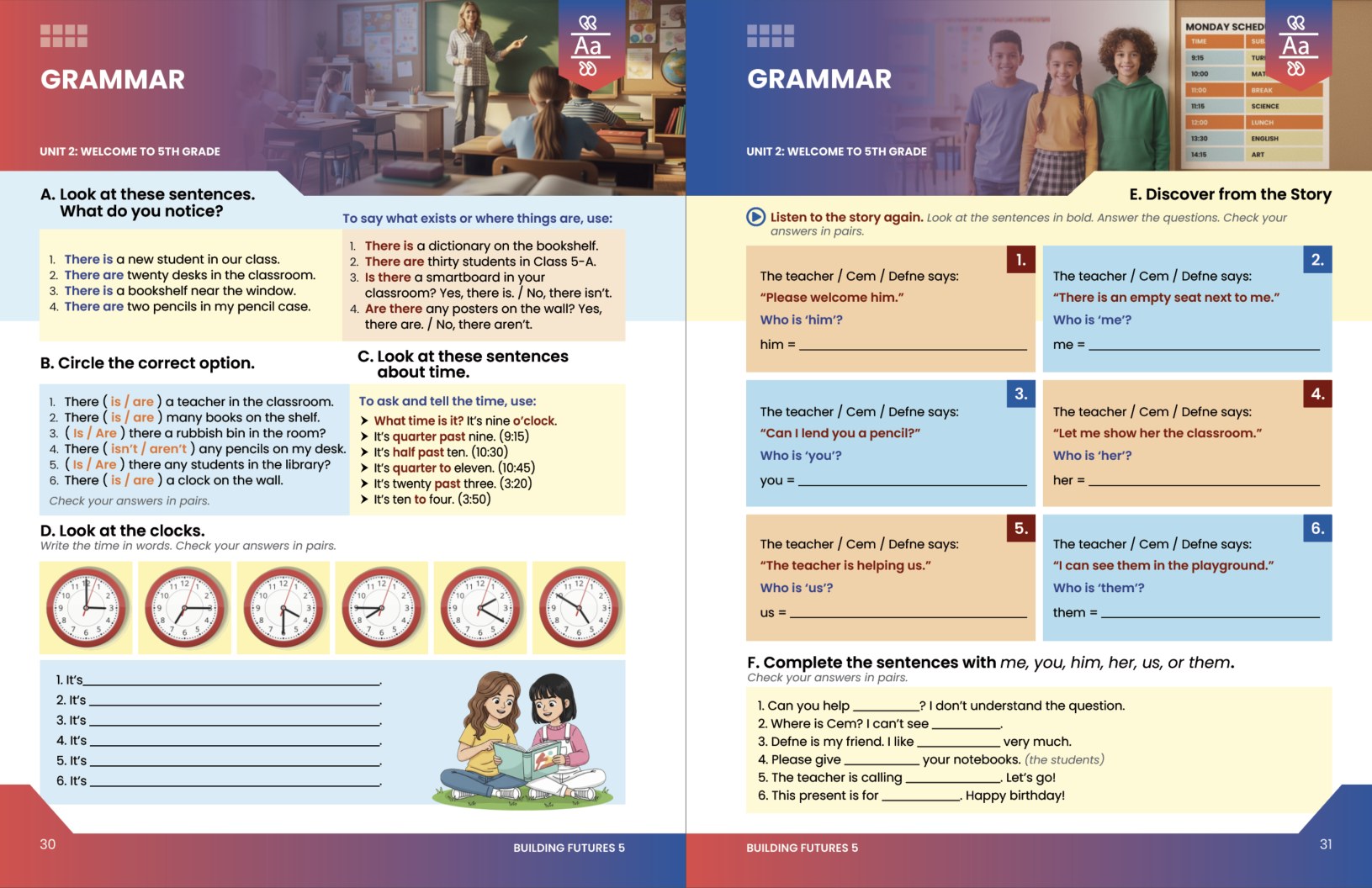
Unit 1's group project: design your ideal classroom (timetable, rules, subjects) and present the poster. There is/are and telling the time, put to work on day one.
Research a wild animal, its habitat and how to protect it, naturally exercising can, must and comparatives: "the lion is the strongest."
An idiomatic social-language strand runs through the book: "Give me a hand!" · "That's the lion's share!" · "This problem is a hot potato!"
The time-travel
grade
- Learners break out of the present. Grade 6 is where pupils start narrating the past (simple past, was/were) and planning the future (will, be going to). Telling real stories in English.
- Question tags as a signature skill, built systematically across present, past and future. Conversational English that sounds genuinely fluent.
- Eight built-in CLIL modules: the International Space Station, rainforests, bike-friendly cities, young inventors. A light CLIL programme inside the English course.
- Three text encounters per unit (animated story + theme reading + CLIL reading): unusually high input mileage for the level.
- Structures like question tags and comparatives acquired without ever meeting a rule. Reassuring for parents, distinctive against competitors.
one CLIL per unit
CLIL vocabulary
across the book
Content worth learning
a language for
The flagship unit tours world cuisines in the simple past. Its CLIL module then zooms out to climate zones: why different places grow and eat different foods.
Learners read how astronauts eat, sleep and exercise on the ISS, then build a "Day in Space" schedule comparing an astronaut's day to their own.
Unit 1's performance task: pupils design their own board game or quiz with numbers 100–500 and ordinals, write the rules, and teach classmates to play.
The B1 bridge
- The crossing into independent-user territory. Learners move from describing to explaining, justifying and predicting: comparatives, past narration, will, must/should, reasons with because.
- Two projects in every unit: a collaborative in-class build plus a fully independent homework project. 20 portfolio artefacts per learner across the book.
- Item-for-item syllabus compliance: 10 official themes, 63 official outcomes, and all 177 wordlist items, with zero off-list vocabulary permitted.
- Speaking as a full section with a compulsory movement task in every unit, recycling only language learners have already met.
- Edition note: built to the current official Grade 7 syllabus, with the Maarif values framework woven through. A fully Maarif-native edition is in development.
+ homework
zero off-list
mapped
From national heroes
to the planets
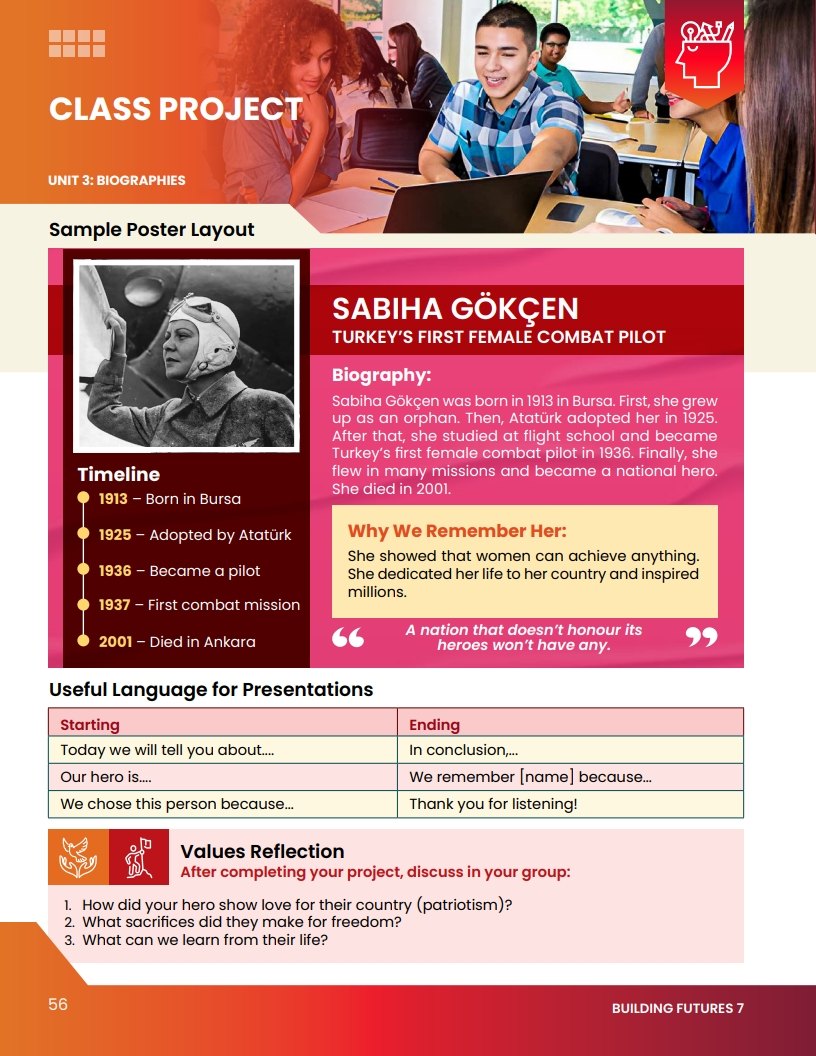
A podcast-format listening, "Atatürk: Father of a Nation," pairs with the reading "Heroes Who Shaped History" and a National Heroes Exhibition poster project. Curriculum and values alignment in one spread.
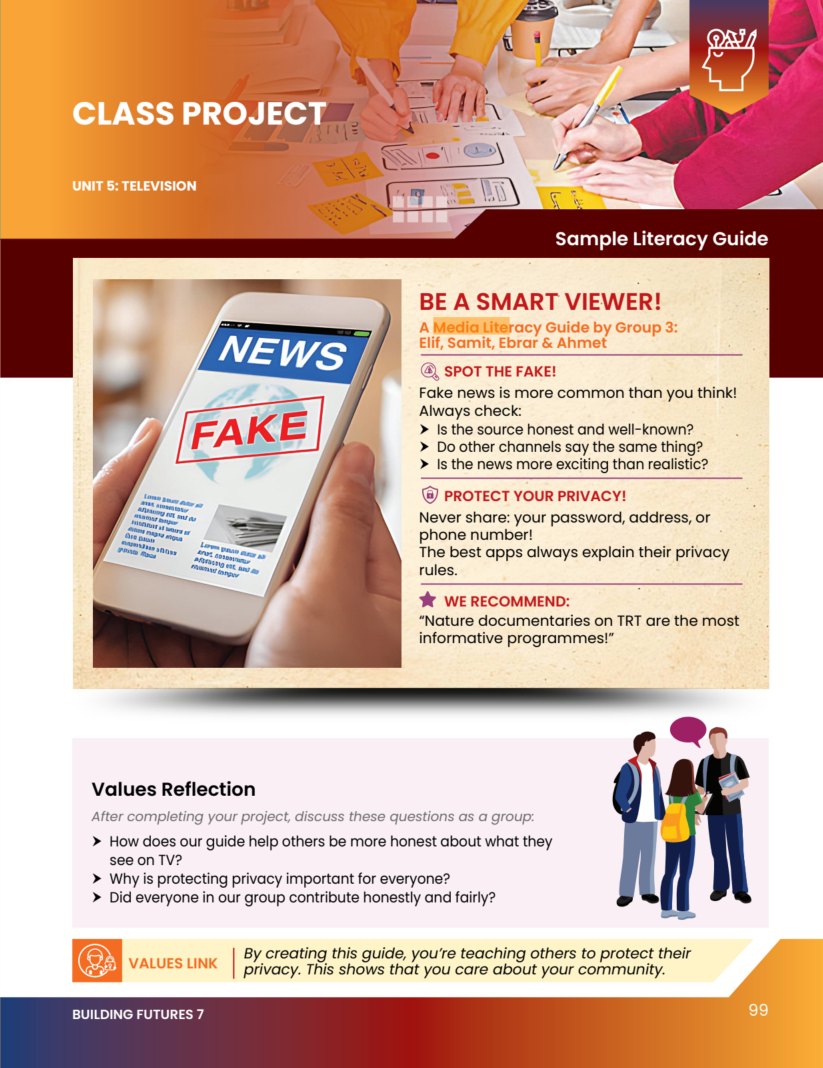
"Can You Trust What You See?" tackles fake news and online privacy, and learners build a Media Literacy Guide for their peers. The book's strongest modern-relevance unit.
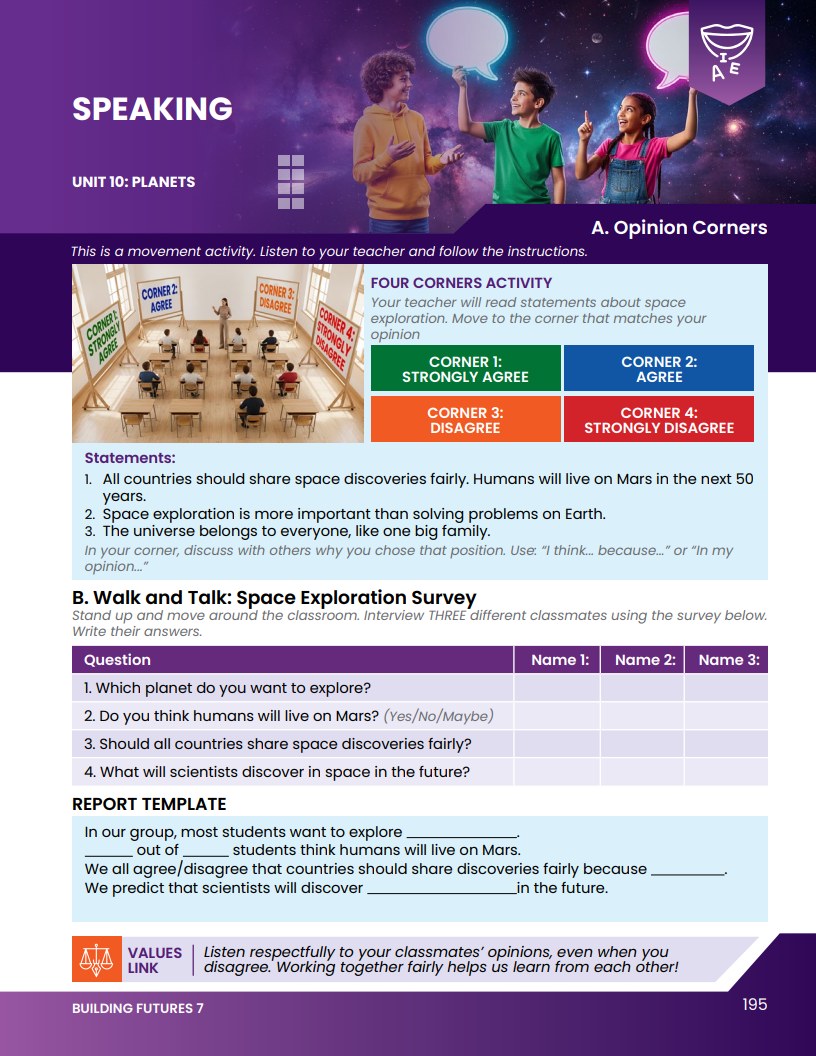
A debate on fair access to space, the reading "One Universe, One Family", and a class exhibition of planet fact cards. Science content carried by comparatives and predictions.
Grade 6,
at full depth
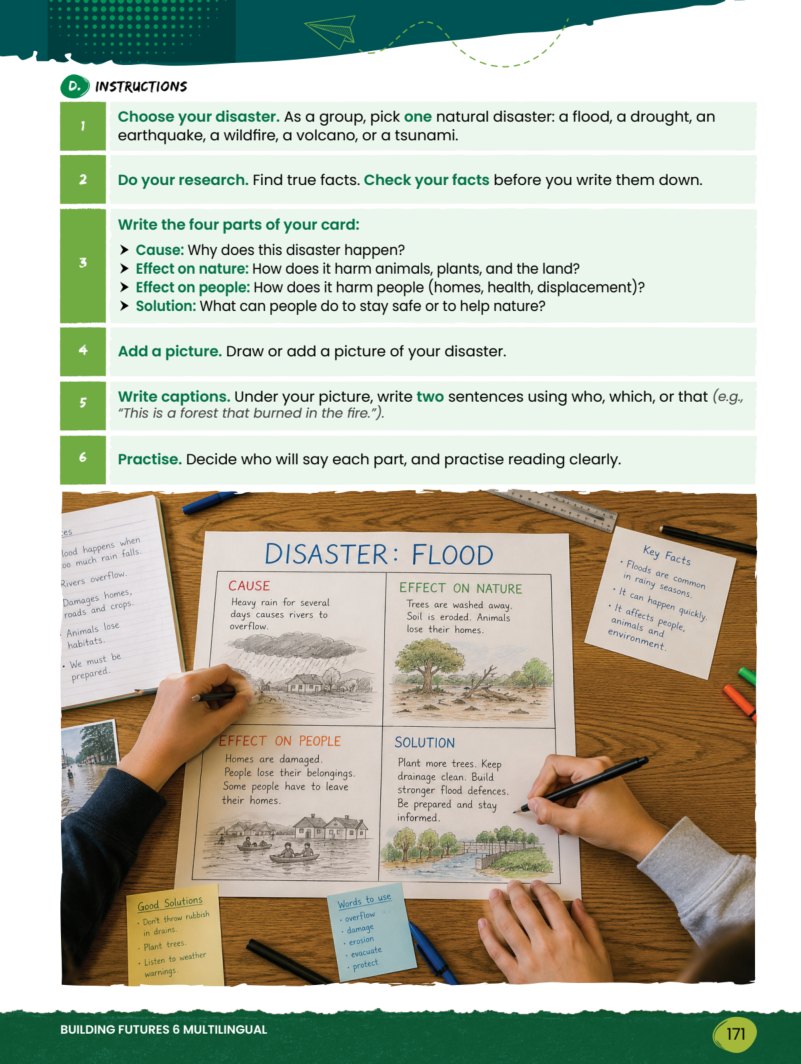
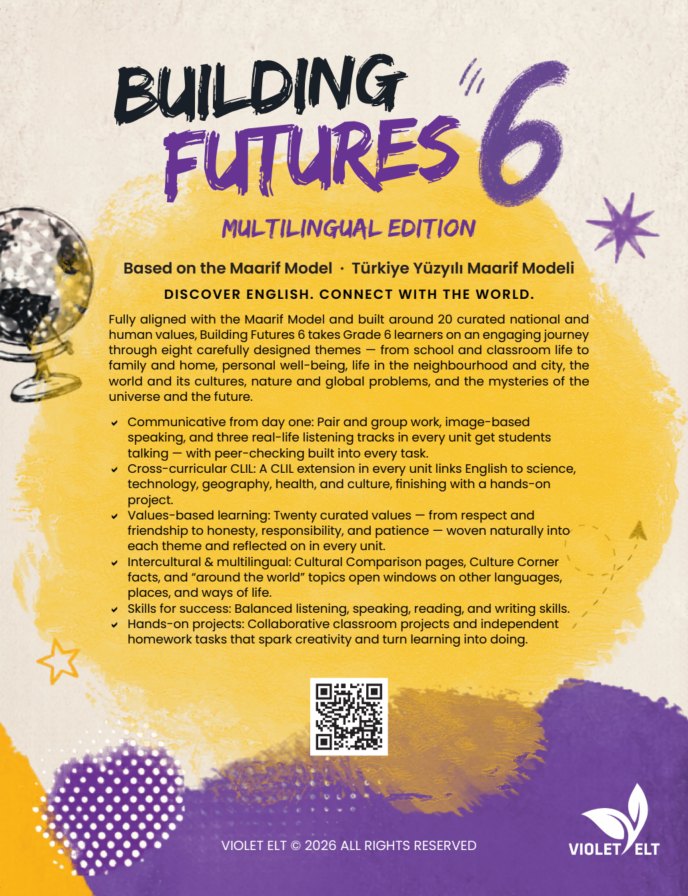
- Purpose-built for the new Maarif Grade 6 curriculum, not a re-skin. Vocabulary only from the ministry list; every unit's project is the official Performance Assignment.
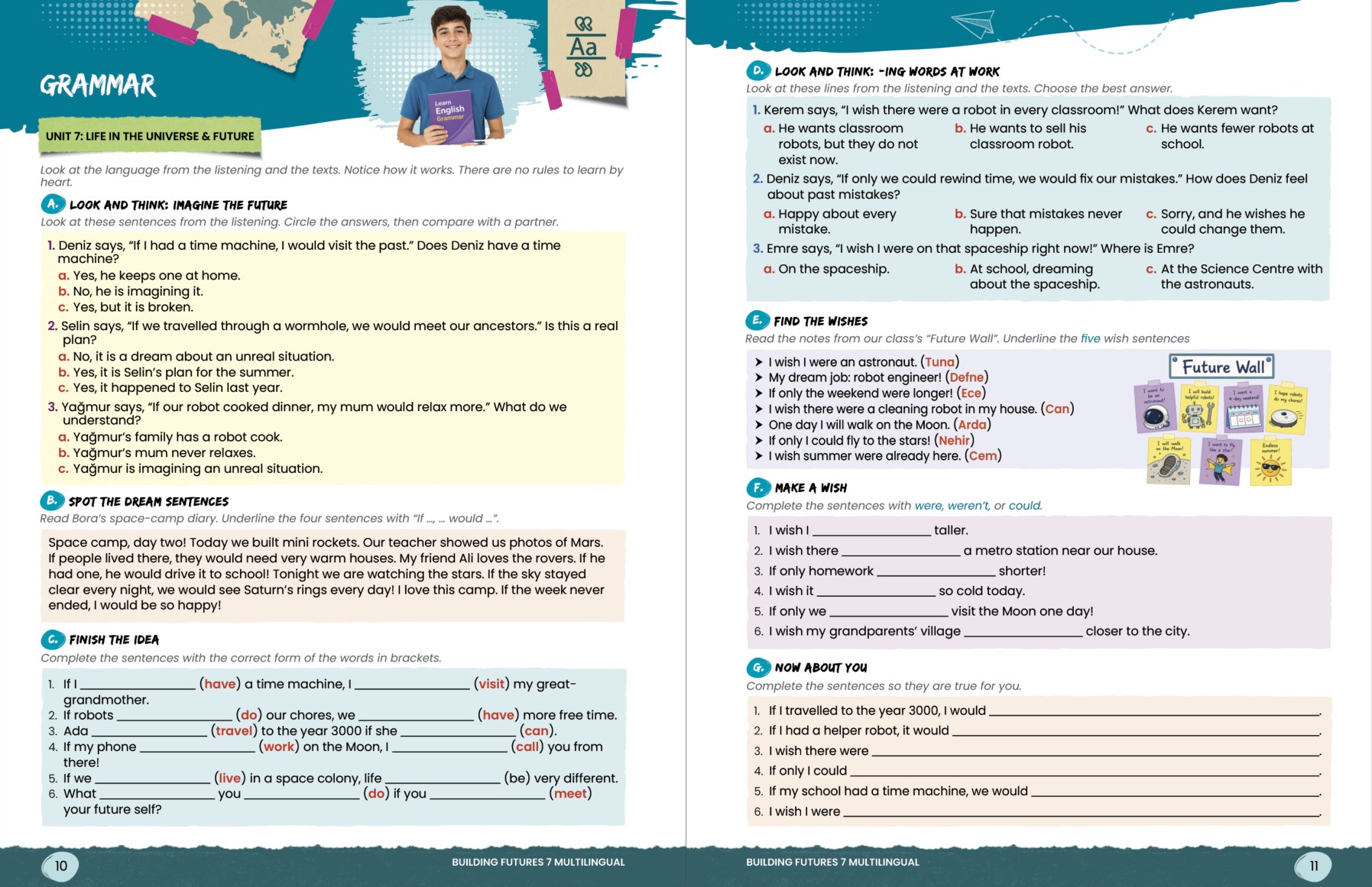
- A complete lower-secondary grammar arc in one year: perfect tenses, modals of deduction, relative clauses, conditionals. All as chunks-in-context, no rules.
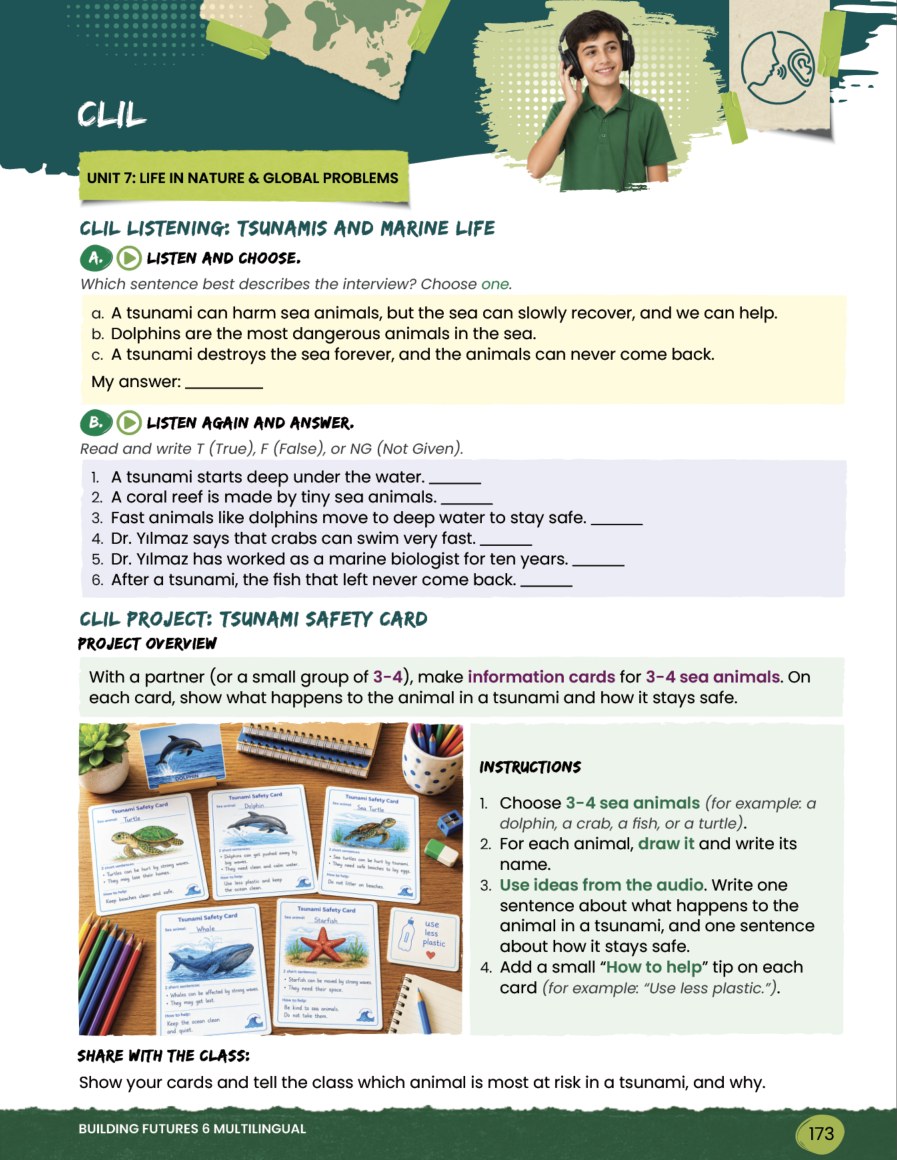
- An integrated one-page CLIL module in every unit: a homework app built by a 12-year-old, bike-friendly cities, tsunamis and marine life.
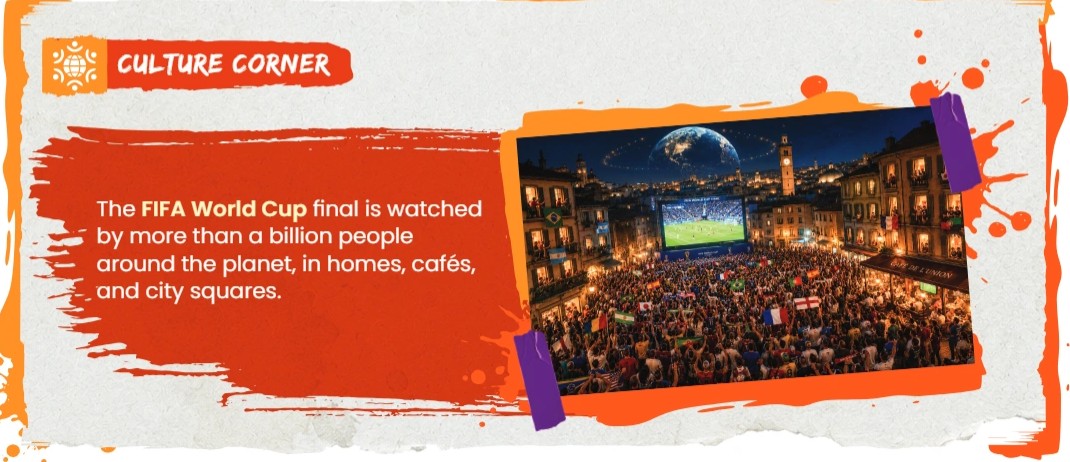
- Cultural Comparison and Culture Corner in every reading, from Japan's o-souji to Finland's recess.
- Teen-true texts with naturalness-controlled audio: chat threads, vlogs, podcasts, voice messages that sound like real speech.
teacher glossaries
pieces
gradeable items
Real-world connections,
page after page
Pupils at a Turkish school fix real problems (an access ramp, a quiet hour, a peer-mentorship plan), paired with a reply from "Mei in Tokyo" about daily student cleaning.
A school-podcast interview with Kerem, 12, who built "HomeworkBuddy". Then the project "My School App Idea": sketch an app that fixes a problem in your own school.
The finale turns conditionals into space scenarios ("If we live on Mars, we will…"), closing with a "Life in Space" crew role-play.
The capstone
- The step-up grammar that unlocks real expression: passives across present, past and future, causatives, the second conditional, relative clauses, wish / if only. All kept accessible as usable chunks.
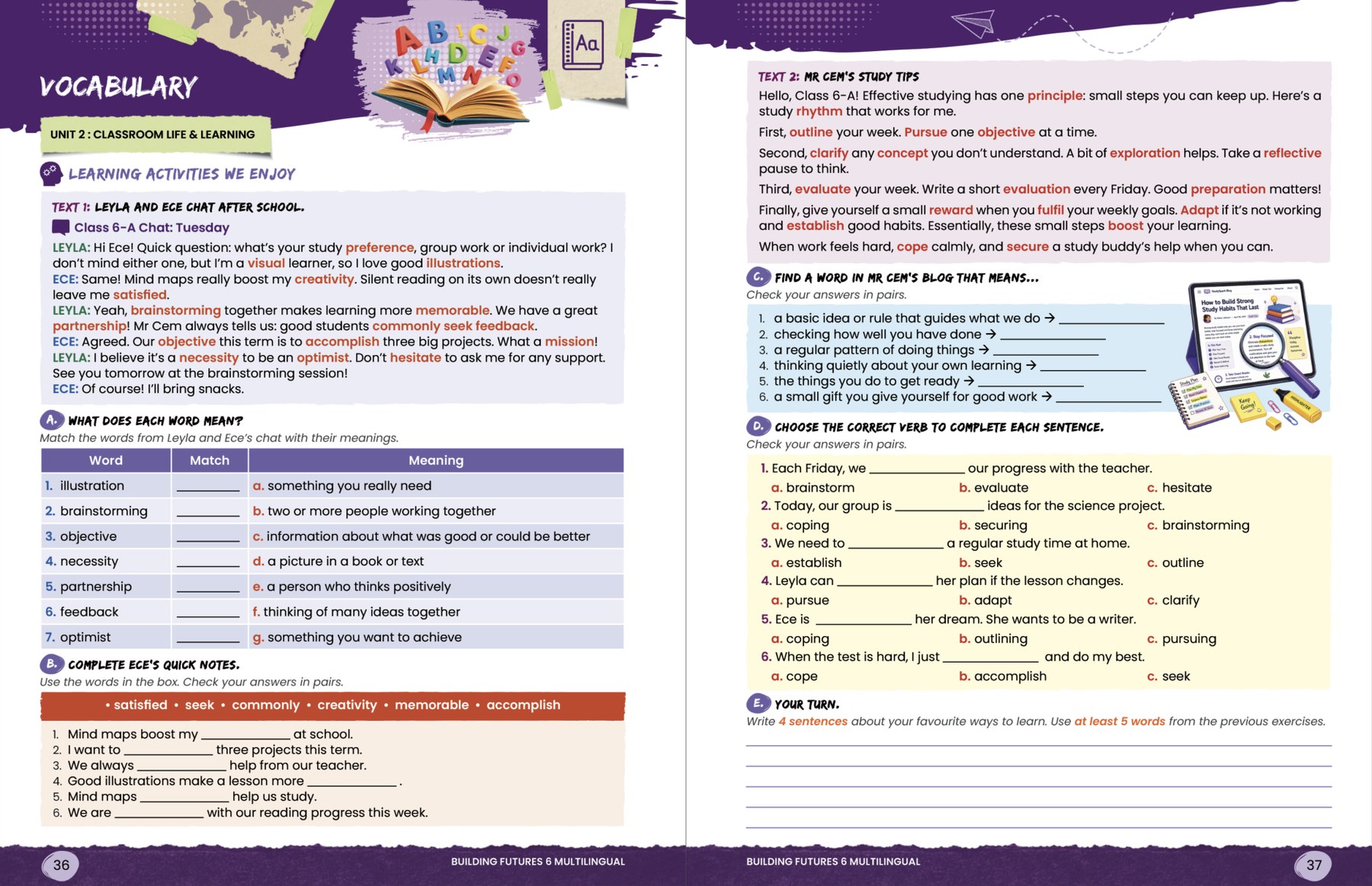
- A vocabulary engine built for a heavy syllabus: ~583 target items in two-context mini-cycles, with ≥80% of every cluster actively practised. Nothing "dumped".
- Themes that grow up with the learner: social media and sleep, helping your neighbourhood, global problems, time travel and robots.
- The intercultural identity made concrete. Every unit ends with a peer from another country, a research question, and a share-worthy world fact.
- Each unit's project is the ministry Performance Assignment, redesigned as a classroom-ready group activity.
zero grammar jargon
items
rigour you can audit
From Göbeklitepe
to the year 2075
The most imaginative unit: a story called "A Robot Joined Our Family", the second conditional, a "My Week in 2075" writing task, and a labelled "Future Helper Robot" design.
A neighbourhood social feed ("The Mahallem App"), a class Mini Magazine, and a "Helping Hands Map" of local places that support people. The book's civic heart.
The gold-standard opener: three listening tracks, a student blog, an event-brochure project, and a CLIL page on visiting Ephesus, Cappadocia and Göbeklitepe responsibly.
vBook: the whole series,
on the board
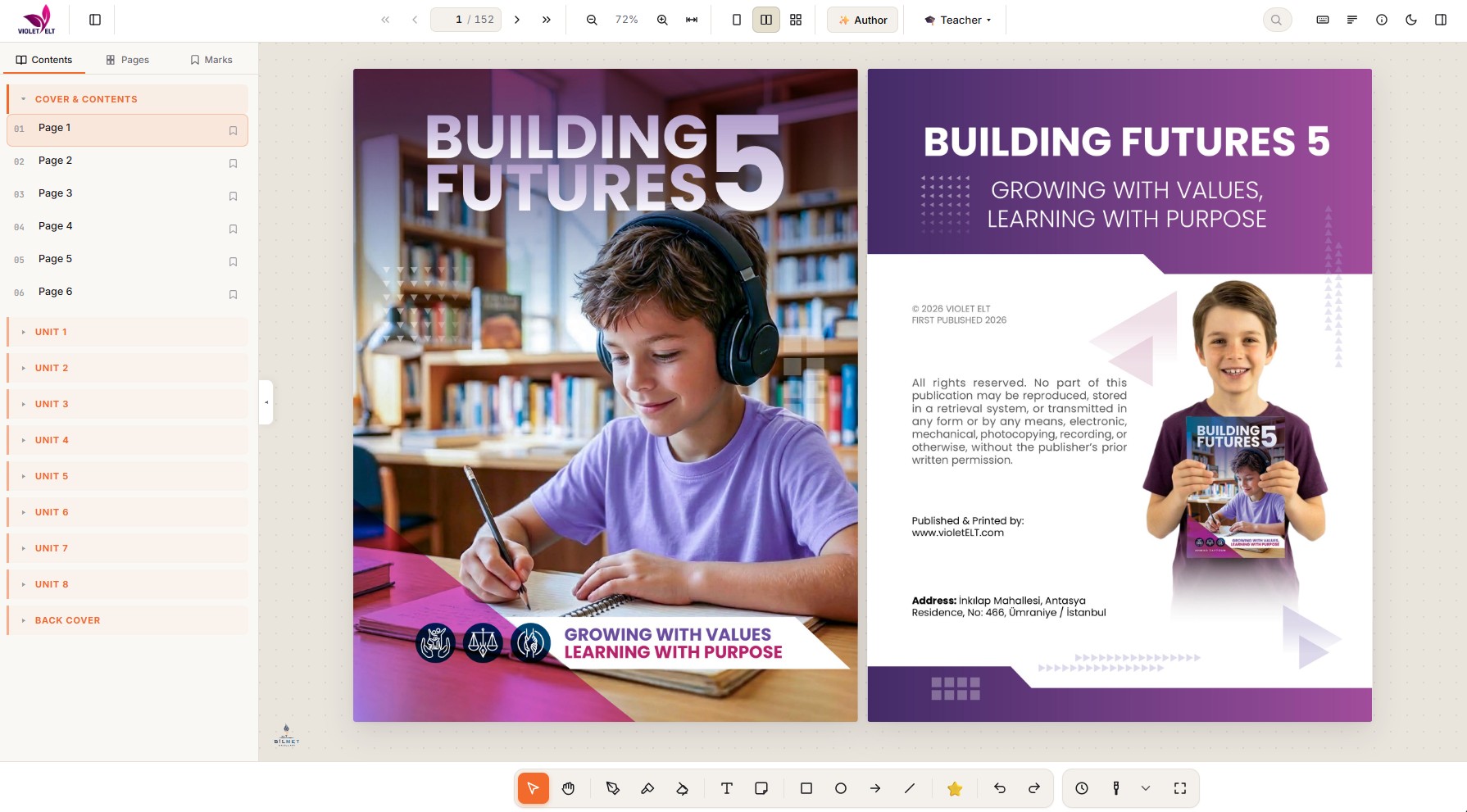
Every level comes with vBook, the series' interactive whiteboard software. The complete course lives on screen, so teachers run the whole lesson from the front of the room.
Every page of the coursebooks, zoomable and navigable for front-of-class teaching.
The digital stories, listening tracks and videos play from the very page they belong to.
The grammar guide and vocabulary lists, one tap away at any moment of the lesson.
Reveal the answer key on the page for instant whole-class checking.
Let's build
futures together.
Adoption options, samples and commercial details:
we'd love to discuss them with you in person.